

Written by: m.wilson – AI Assisted
Is it scientifically possible for parents with no viable eggs to produce an embryo that will inherit their combined DNA? If the so-called “designer babies” can achieve a desired eye color, how about a set of probable traits? Well, as it turns out, no scientist has successfully or legally changed a human’s eye color using gene-editing technology. Moreover, changing a baby’s eye color doesn’t appear to be legal. It has not been performed on humans due to significant ethical concerns, safety risks, and regulatory prohibitions in the U.S. and many other countries.
Changing eye color remains a theoretical possibility at the embryonic stage, and would work by targeting genes like OCA2 and HERC2 that control melanin production.
CRISPR/Cas9 GENE-EDITING TOOL
The only known case of gene-edited babies remains the twin girls born in China in 2018, whose creator, He Jiankui, was widely condemned by the scientific community and imprisoned for illegal medical practices. He has since been released and is reportedly back in the lab. He Jiankui’s procedure for the twin girls, Lulu and Nana, involved using the CRISPR/Cas9 gene-editing tool on human embryos during an in vitro fertilization (IVF) process, with the goal of creating resistance to HIV infection. Unfortunately, no public pictures or visual links of Lulu and Nana are available. Their pseudonyms are used specifically to maintain anonymity. The only images circulated during the 2018 announcement were stock or lab photos provided by He, not actual pictures of the children’s faces. As of 2025, the exact health status and location of Lulu and Nana remain unknown due to strict privacy protections and the sensitive nature of the case. Their personal information, including names, location, and medical details, have been kept confidential by the Chinese authorities and their families to ensure they can live a normal, undisturbed life.
It has also come to light that a third child was born. A court in Shenzhen found He and two collaborators had forged ethical review documents and misled doctors into unknowingly implanting gene-edited embryos into two women. One gave birth to twins in November 2018, and it is not clear when the third child was born. In fact, there is almost no information readily available about this third child at all. – GET ANIMATED Medical
He Jiankui has stated publicly in interviews since his release from prison that all three children are healthy and living normal lives. The third child’s parents reportedly divorced, and He provides financial support to the single mother. The third child was later revealed to have the pseudonym “Amy.”

Today in 2025, current U.S. regulations prohibit editing genes in embryos that could result in a pregnancy; however, there’s been significant progress in using gene editing as a treatment for existing individuals with severe diseases after birth. For example, this past February (2025), a team at the Children’s Hospital of Philadelphia (CHOP) and Penn Medicine administered a customized in vivo (within the body) CRISPR gene-editing therapy to Baby “KJ” at six months of age. He was born with severe carbamoyl phosphate synthetase 1 (CPS1) deficiency, a rare and life-threatening condition where the body cannot process ammonia, leading to potential neurological injury.
He received subsequent doses at approximately 7 and 8 months and was ultimately discharged from the hospital after 307 days, celebrating his tenth-month birthday. In any event, CRISPR technology can alter an embryo, but using it to make a donor egg or embryo genetically “resemble” its parents is currently not known to be possible due to the Complexity of Resemblance: Genetic resemblance is a result of millions, if not billions, of specific DNA base pairs and their complex interactions. CRISPR/Cas9 is a precise tool for cutting or replacing small, targeted snippets of DNA (a few base pairs) to disable a gene or correct a specific single-gene mutation. There are also Safety and Efficacy Issues: such as unintended and potentially dangerous consequences, like off-target mutations, large deletions, or even the loss of entire chromosomes.
SOMATIC CELL NUCLEAR TRANSFER
So then how about cloning technology – Somatic Cell Nuclear Transfer (SCNT)? Could it create an embryo with nearly the same nuclear DNA as its combined parents? Maybe not, since SCNT has only been successful using a single donor, producing a near-perfect genetic match (a “delayed identical twin”) of the somatic cell (any body cell other than a sperm or egg). The process involves the insertion of the body cell of the person to be cloned into a donor egg that has had its own nucleus removed. The resulting egg is stimulated to develop into an embryo with the donor’s genetic blueprint, and would have the same nuclear genome as the somatic cell donor. Therefore, this type of cloning doesn’t allow for “designing” specific cosmetic traits or mixing the genes of two parents to create a resemblance.
WHAT MIGHT WORK
In Vitro Gametogenesis (IVG) is looking like a great candidate for helping a male and female couple with viable sperm but no viable eggs, for example, to have a baby that combines their DNA.
Scientists are currently developing a technique called in vitro gametogenesis (IVG), which involves taking somatic cells (like skin or blood cells) from two individuals and reprogramming them to make induced pluripotent stem (iPS) cells, then coaxing those stem cells to become functional sperm and egg cells in the lab. It’s a series of intricate biological processes of gamete formation and proper genomic imprinting.
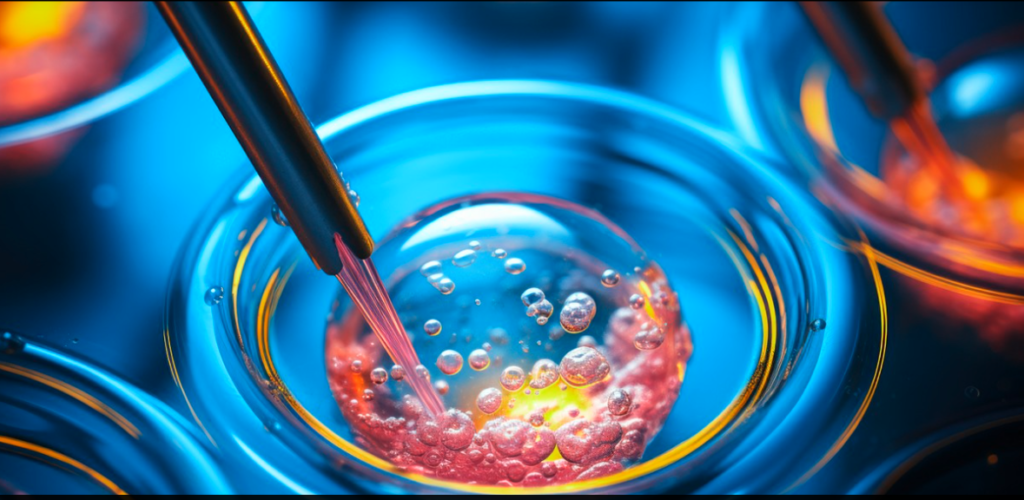
Scientists in Japan and elsewhere have successfully used IVG to create healthy, fertile offspring in mice, and the next generation was also fertile. It’s been effective for human cells as well, and researchers have made significant strides in creating these induced pluripotent stem cells (iPSCs) from human adult cells (such as skin or blood cells) and guiding them into primordial germ cells (precursors to eggs and sperm). This procedure has not yet been performed on humans due to significant ethical concerns, safety risks, and regulatory prohibitions in the U.S. and many other countries. However, in September 2025, researchers at Oregon Health & Science University successfully created early human embryos from skin cell-derived eggs using a complex technique, demonstrating a key proof of concept! Experts currently estimate it is at least five to ten years away – or potentially even decades with human trials and FDA approval, etc.
